Last updated October 30, 2026
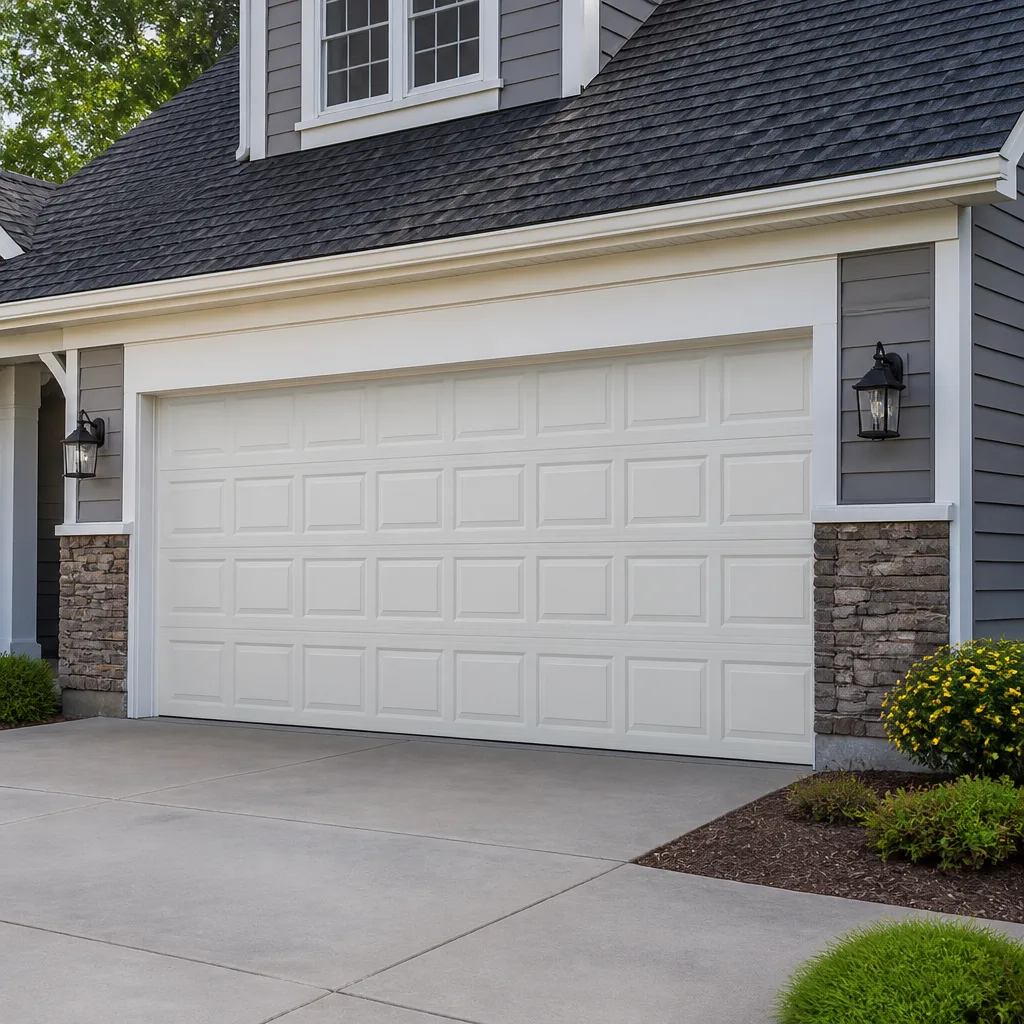 Raised-panel steel
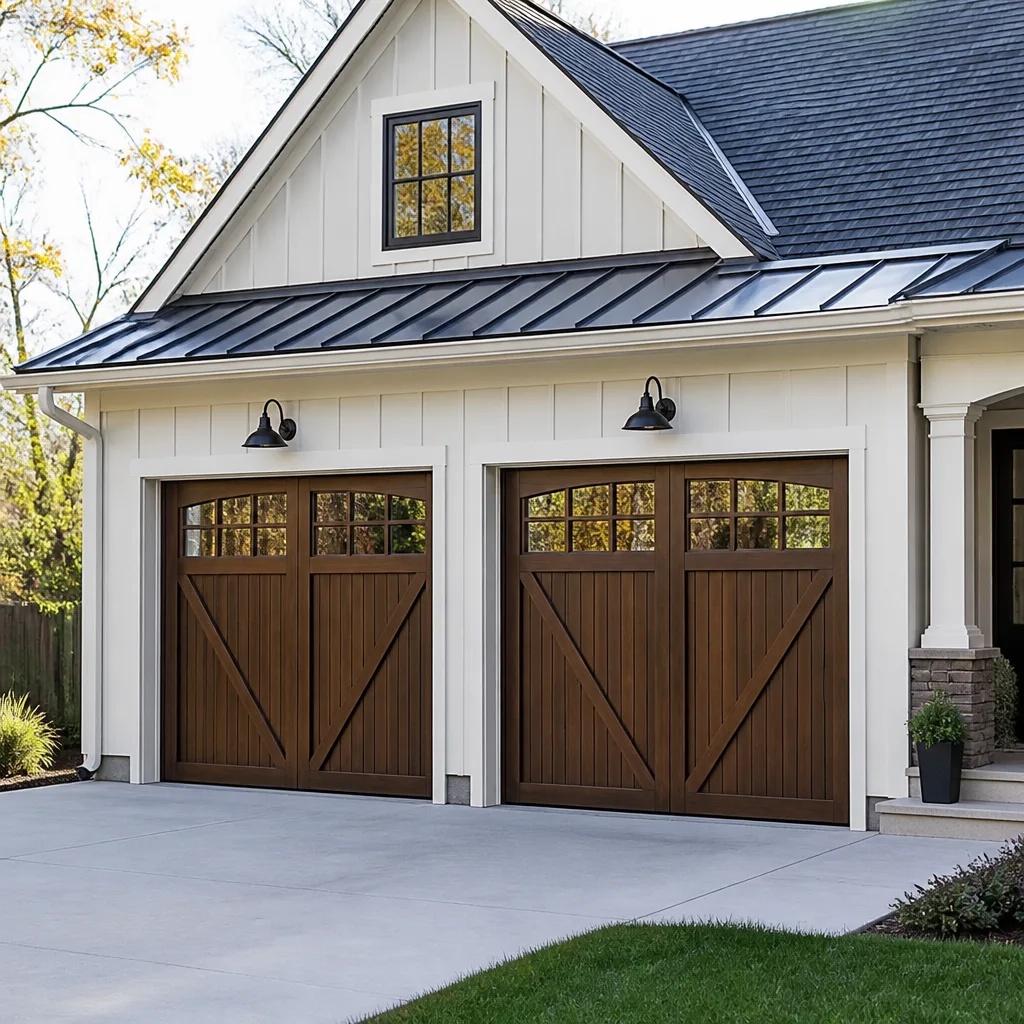 Carriage house
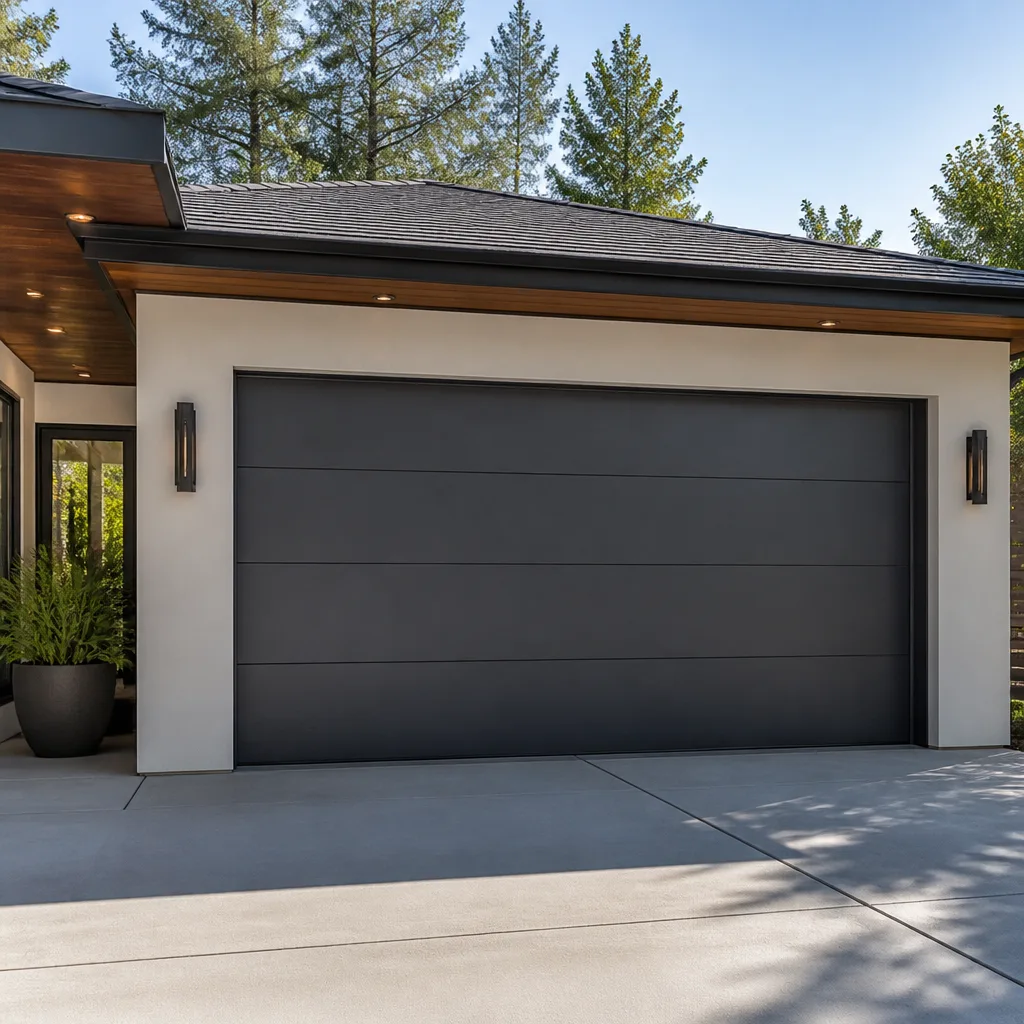 Modern flush
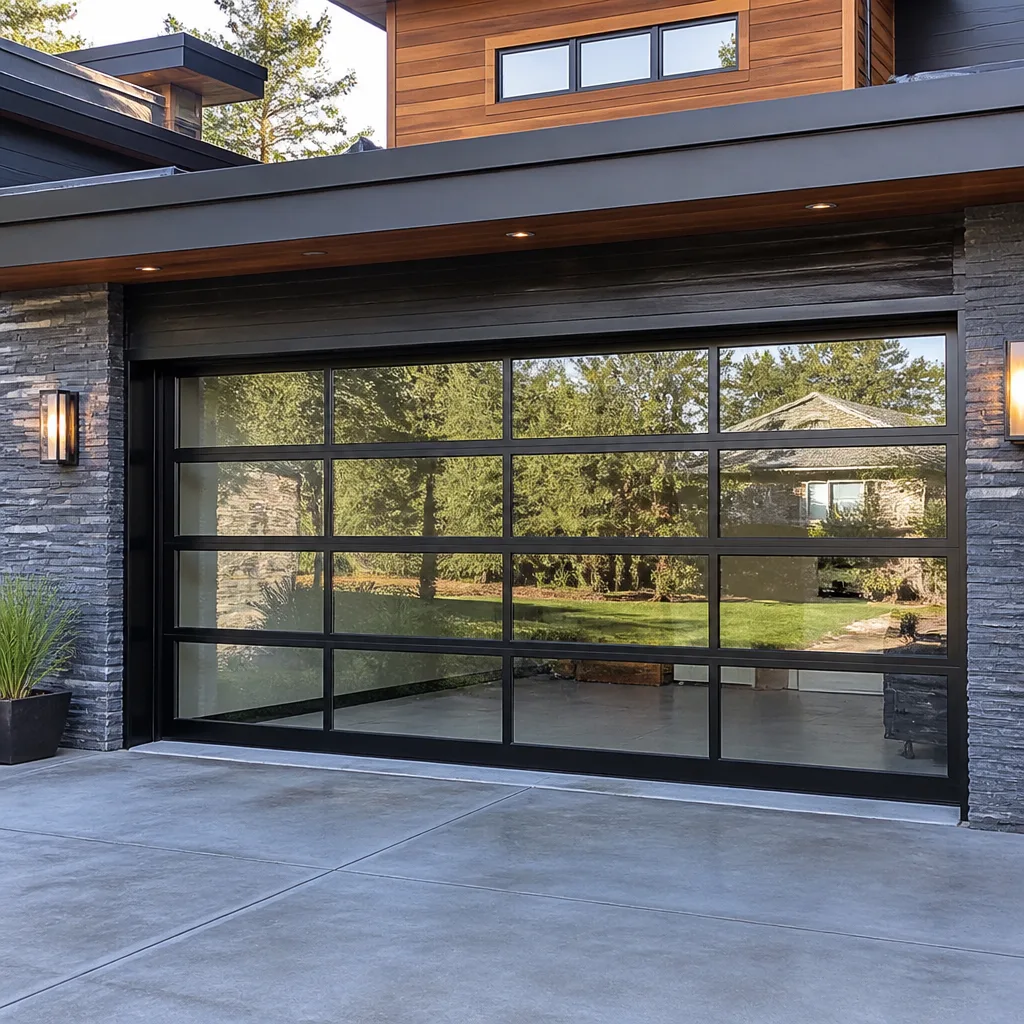 Full-view glass
 LiftMaster openers
 Chamberlain openers
Full 25-point door and opener safety check with every visit - springs, cables, rollers, tracks, and your LiftMaster or Chamberlain opener included
You get a price before we start. It does not change when the truck arrives.
Get your free estimateDIY vs Professional Garage Door: The Hollywood Homeowner’s Decision Guide
Every year in Florida, roughly 30,000 people end up in emergency rooms because of garage door injuries, and the overwhelming majority of those involve torsion springs, the high-tension coils that do the actual lifting. The question isn’t really whether you’re handy enough to replace a garage door spring. It’s whether the $150 you save is worth the liability if an improperly installed door fails during a hurricane and your insurance company finds a reason to deny the claim. This guide walks through which garage door tasks a Hollywood homeowner can safely handle, which ones you shouldn’t touch regardless of skill level, and how Florida’s specific building codes and insurance rules shift the risk calculus in ways most online guides never mention.
Styles & brands we work with
Quick Answer
Most garage door maintenance tasks in Hollywood, FL are safe for a careful DIYer: weatherstripping replacement, sensor realignment, track lubrication, and remote reprogramming. But torsion spring replacement, cable work, panel replacement, and any new door installation should be handled by a licensed professional because the injury risk is severe and Florida’s wind-load codes and permit requirements create legal and insurance consequences that a DIY job can’t satisfy.
Table of Contents
- The Real Question: Risk Exposure, Not Skill
- What’s Actually Safe to DIY: 5 Tasks You Can Handle This Weekend
- The Danger Zone: Torsion Springs, Cables, and Why They Injure Professionals Too
- Florida Code Compliance: Permits, Wind Ratings, and Insurance Reality
- The Cost of Getting It Wrong: Misdiagnosis vs. Professional Diagnosis
- Hollywood-Specific Factors: Salt Air, Hurricanes, and Older Housing Stock
- The DIY Installation Trap: Why Saving $800 Can Cost You $20,000
- Common Mistakes to Avoid
- When to Call a Professional
- Frequently Asked Questions
- The Bottom Line
The Real Question: Risk Exposure, Not Skill
Most DIY-versus-professional discussions start with an honest assessment of your mechanical ability. Can you follow a YouTube tutorial? Do you own the right tools? Those questions matter, but they miss the point. The more useful question is what you’re exposing yourself to if something goes wrong. A misaligned sensor won’t hurt anyone, but a garage door that comes off its track can weigh between 130 and 400 pounds depending on the material, and a torsion spring under tension stores enough energy to break bones or kill if it releases unexpectedly.
We’ve been called out to homes across Hollywood, from the 1950s ranch houses near Young Circle to the newer construction west of I-95, and the pattern is consistent. The DIY failures we see rarely involve someone who didn’t know what they were doing. They involve someone who underestimated what could go wrong. In our experience, a homeowner who has successfully replaced a bathroom faucet will sometimes assume a garage door spring is the same category of task. It isn’t. The spring is holding hundreds of pounds of loaded tension, and the failure mode isn’t a leak on the floor, it’s a steel bar traveling at high velocity toward your face.
So the real decision framework isn’t “am I capable.” It’s “what happens to my body, my house, and my insurance coverage if I’m wrong.” In Florida, that last category carries consequences that homeowners in other states never consider.
What’s Actually Safe to DIY: 5 Tasks You Can Handle This Weekend
We don’t want to give the impression that every garage door task requires a service call. That would be dishonest, and it would waste your money. There’s a meaningful list of maintenance items that a Hollywood homeowner can handle with basic tools and about an hour. Here’s the honest list, and you can find more guides & resources on our blog:
- Weatherstripping replacement. The rubber seal along the bottom of the door and the weatherstripping around the frame degrade fast in Hollywood’s salt air and humidity. When you see daylight under the door or feel a draft, replacing the seal is genuinely simple. Pull out the old strip, slide in the new one, trim to fit. No tension involved, no permit required.
- Sensor realignment. If your door reverses for no reason or the opener light blinks and won’t close, the photo-eye sensors near the floor have likely been bumped. Loosen the wing nut, adjust the sensor until the indicator light stays solid, tighten. This is a 15-minute fix that saves a service call.
- Track and roller lubrication. A garage door that’s getting louder is often just dry. White lithium grease on the hinges and rollers, and a silicone spray on the torsion spring (yes, the spring itself can be lubricated safely without touching the tension system), will quiet things down. Do this twice a year in Hollywood because the humidity accelerates rust and the salt air corrodes exposed metal.
- Remote reprogramming. If your opener remote stopped working and the wall button still operates the door, you likely just need to reprogram the remote. Most LiftMaster, Chamberlain, and Genie openers have a “learn” button on the motor unit. Hold it, press the remote, done. No technician needed.
- Annual visual inspection. You should be looking at your cables, springs, and brackets once a quarter. If you see rust on the cables, a gap in the spring coil, or a door that hangs unevenly by more than an inch, those are signs to call a professional. But the inspection itself is free and you should do it yourself.
The common thread in all five tasks: none of them requires you to touch anything under tension, none involves lifting the door’s full weight manually, and none creates a code or insurance issue. That’s the line. Cross it, and the risk profile changes dramatically.
The Danger Zone: Torsion Springs, Cables, and Why They Injure Professionals Too
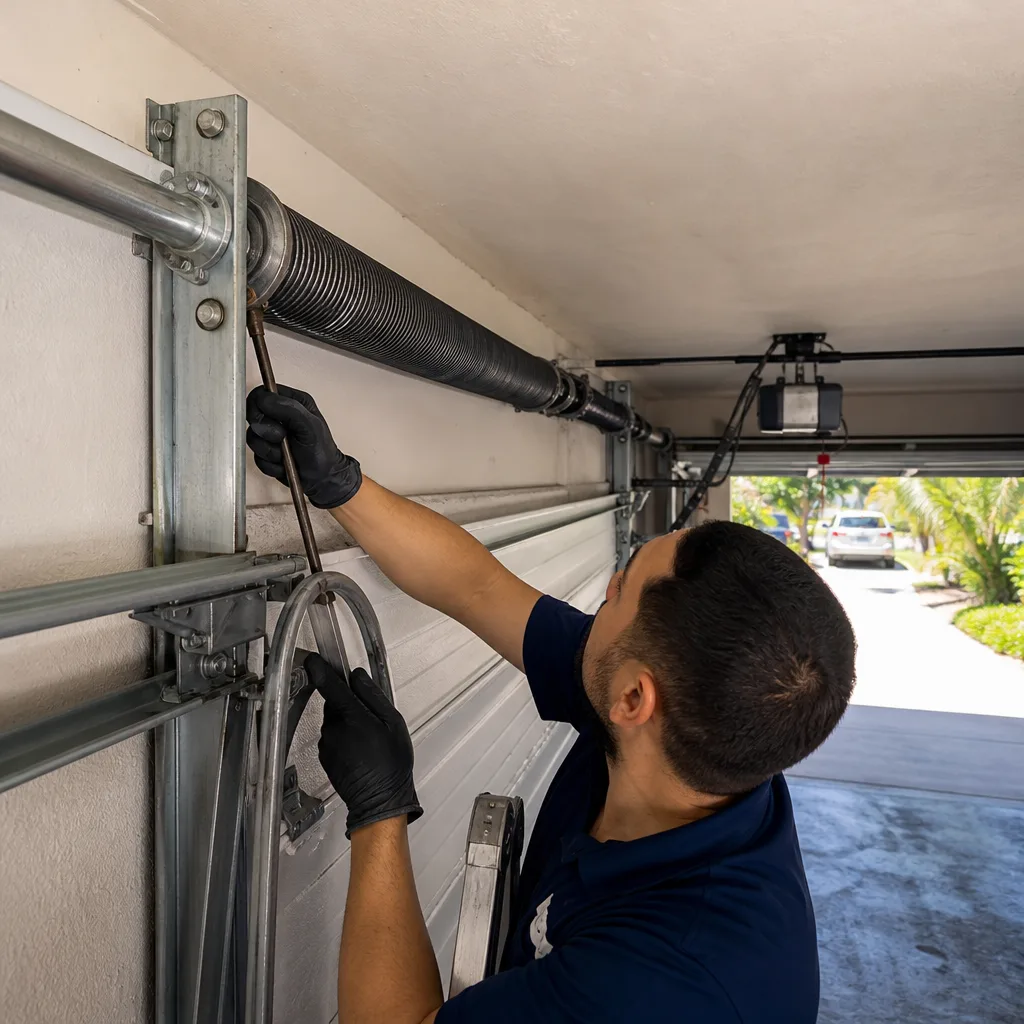
Torsion springs sit on a metal shaft above the garage door opening. They’re wound tight, storing the mechanical energy that makes a 200-pound door feel light enough for a half-horsepower opener to lift. When one breaks, the release of that energy is sudden and violent. The 30,000 injuries per year figure from the U.S. Consumer Product Safety Commission includes professional technicians who do this work daily. Let that sink in: people who repair torsion springs for a living still get hurt.
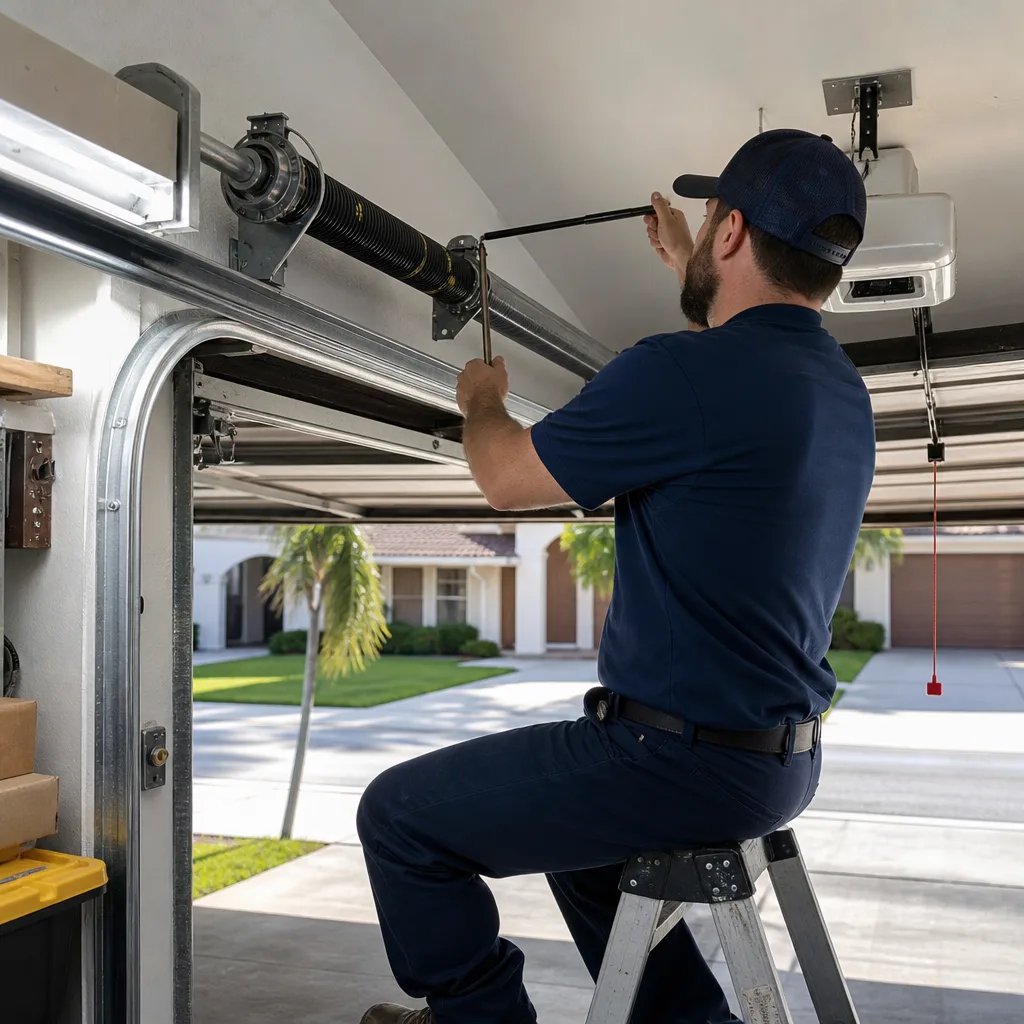
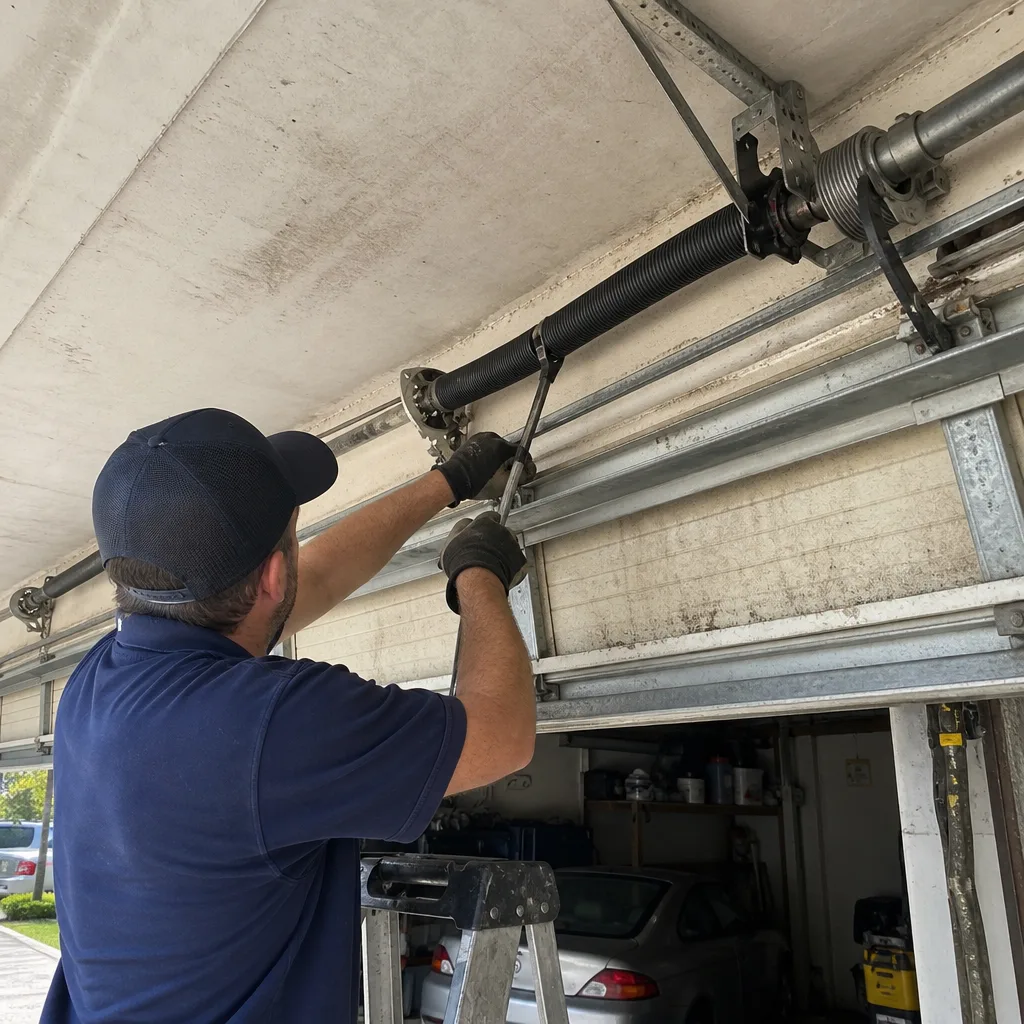
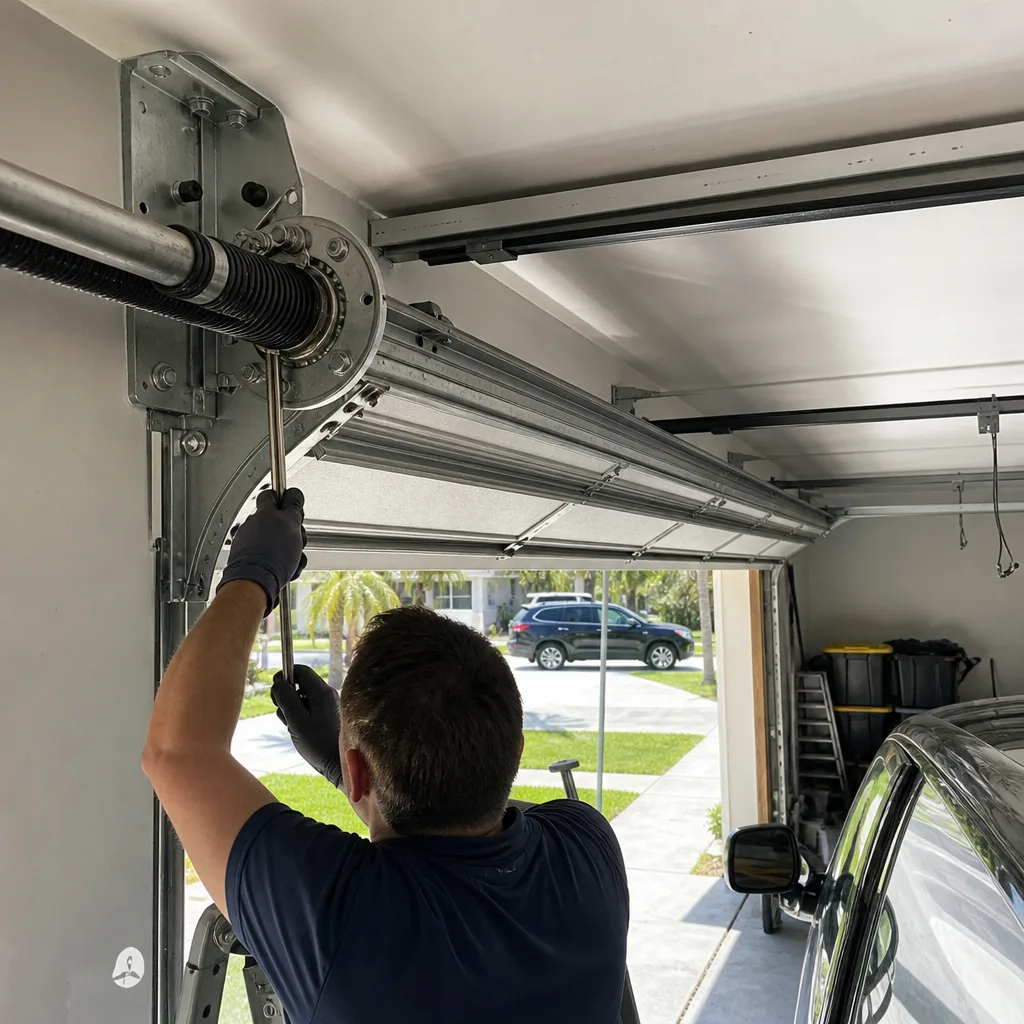
The specific danger is the winding process. To install a new spring, you need winding bars, which are steel rods inserted into the spring’s cone. You apply torque in quarter-turn increments, and when the spring reaches the proper tension, you tighten the set screws. If the bar slips, if the cone fails, or if you lose your grip mid-wind, that spring unwinds instantly. The bar becomes a projectile or your hand gets caught between the bar and the door. Broken wrists, facial fractures, and worse are documented outcomes.
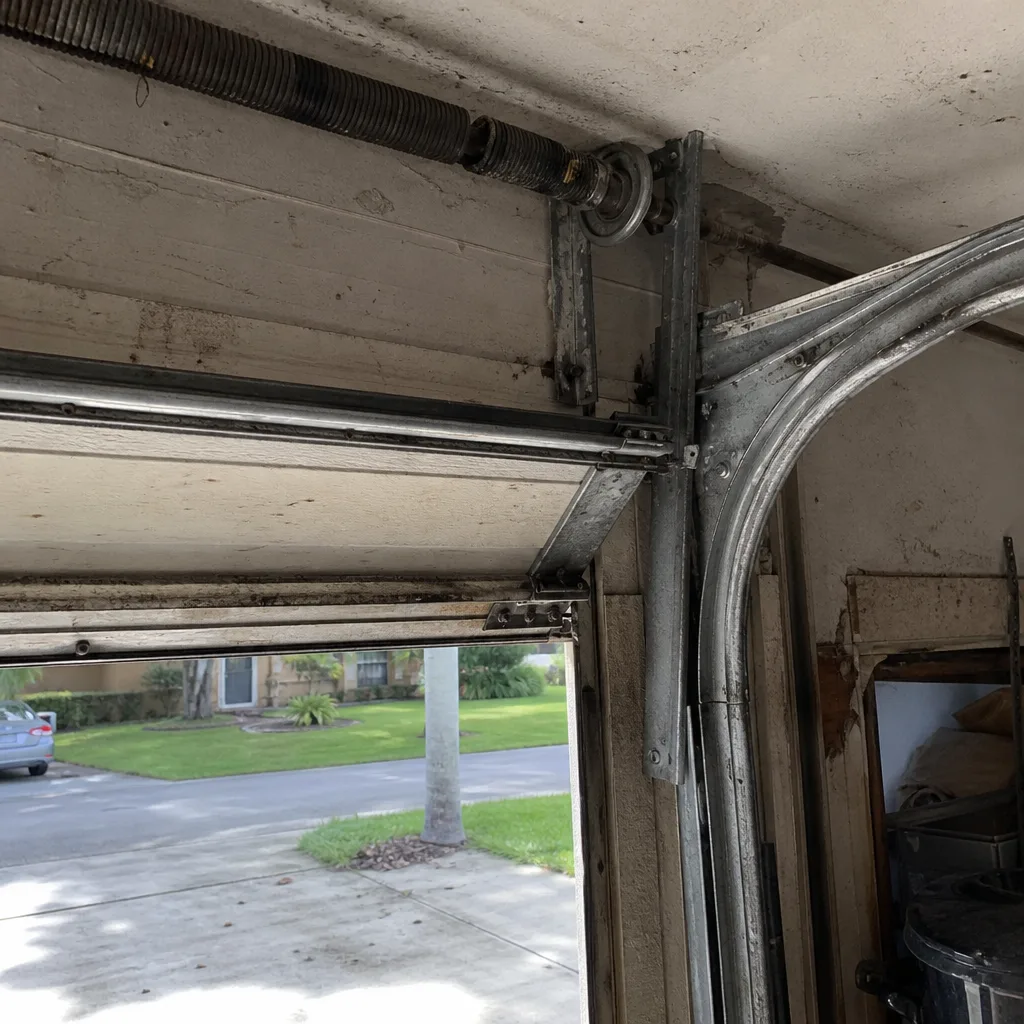
Extension springs, found on older doors (and common in some Hollywood homes built before the 1980s), look less intimidating but carry their own risks. They stretch along horizontal tracks on either side of the door, and when one breaks without a safety cable running through it, the spring flies across the garage. Those springs are under load every moment the door is open.
Cables are the second item on the danger list. The lift cables run from the bottom brackets on either side of the door up to the drums on the torsion shaft. They’re under several hundred pounds of tension even when the door is down. If you remove a bottom bracket or drum without releasing the spring tension properly, the cable can whip. A frayed cable is a warning sign, not a DIY project.
Our position on this isn’t a sales tactic. It’s the same advice any experienced technician in Hollywood would give a neighbor. We replace springs every week. We carry the proper winding bars, the right replacement spring for the door’s weight and height, and we release and re-load tension hundreds of times a year. Even with that repetition, we treat every spring job with focused caution. A homeowner who replaces one spring every ten years, working from a video, is doing the most dangerous version of this job.
Florida Code Compliance: Permits, Wind Ratings, and Insurance Reality
Here’s the part most national DIY guides miss entirely. Florida is not like other states when it comes to garage doors. The Florida Building Code includes specific requirements for wind-load resistance on garage doors, especially in Miami-Dade and Broward counties, which sit inside the High Velocity Hurricane Zone. Hollywood is squarely in that zone.
A new garage door installation in Hollywood requires a permit, and the door must be rated for the wind speed requirements in your specific location. When you pull that permit and list yourself as the contractor, you now own the liability for every code compliance detail. Most homeowners don’t know what “wind load rating” means or how to verify that the door they bought meets the structural requirements for a home in Broward County. A door purchased at a big-box store may or may not meet the Florida Building Code standards for your address.
The permit issue goes beyond the installation itself. Here’s the scenario we’ve seen play out in Hollywood: a homeowner installs their own garage door without a permit, or with a door that isn’t wind-rated for the area. Five years later, a hurricane hits. The garage door fails, wind enters the garage, and the resulting pressure blows out windows and compromises the roof. The homeowner files an insurance claim. The adjuster discovers unpermitted work or a non-compliant door. The claim is denied or reduced. The homeowner is now out the cost of the door, the cost of the damage, and potentially their ability to sell the house until the unpermitted work is corrected.
That title problem is real. Unpermitted improvements must be disclosed at sale, and lenders often require retroactive permits. A garage door installed without a permit can hold up a closing. These are consequences that no YouTube tutorial mentions because most of those videos are made in states where garage door installation is a simple mechanical task with no permit requirement.
Professional installation companies that work in Hollywood pull permits as a standard part of the job. It’s baked into the service because it’s required. That permit creates a record that the work was inspected and compliant, which protects you at sale and during an insurance claim. It’s not a nice-to-have. It’s part of the cost structure, and it’s why a professional installation is more expensive than a Saturday afternoon with a rented truck and a box from a hardware store.
The Cost of Getting It Wrong: Misdiagnosis vs. Professional Diagnosis
There’s a financial argument for professional help that gets less attention than the injury argument. Garage doors fail in ways that look identical but have different root causes. The opener runs but the door doesn’t move. Is the problem the motor, the travel module, the logic board, or a broken spring that you can’t see because it snapped at the coupling? If you guess wrong, you buy a part, install it, and the door still doesn’t work. Then you buy the next part. Then the next.
We’ve arrived at homes in Hollywood where a homeowner has spent $200 on parts and a full weekend of labor trying to fix a door that a technician would have diagnosed in fifteen minutes. The misdiagnosis problem is especially common with opener issues. A Chamberlain opener that won’t respond to the remote could be a dead logic board, a failed capacitor, a stripped gear, or interference from a neighbor’s new smart-home system. The parts for those fixes range from $15 to $180, and they require different repair procedures. Without diagnostic experience, you’re playing parts roulette.
A professional diagnostic call in Hollywood typically runs between $75 and $125, which is often waived or applied toward the repair if you proceed. That diagnostic cost is less than the price of two wrong guesses on parts. And with companies like Benchmark Garage Door Repair, the diagnosis is the product. Technicians trained across eight major brands (LiftMaster, Chamberlain, Genie, Clopay, Amarr, Wayne Dalton, Craftsman, and Raynor) test against a measurable standard before recommending any fix, so the recommendation follows the condition of the door, not the margin on a particular part.
The math matters. Two wrong parts are $40 to $100 each. The diagnostic call is a fixed fee that ends in a correct answer. If you’re on a budget, the diagnostic route is the financially rational choice, even before you factor in the value of your time.
Hollywood-Specific Factors: Salt Air, Hurricanes, and Older Housing Stock
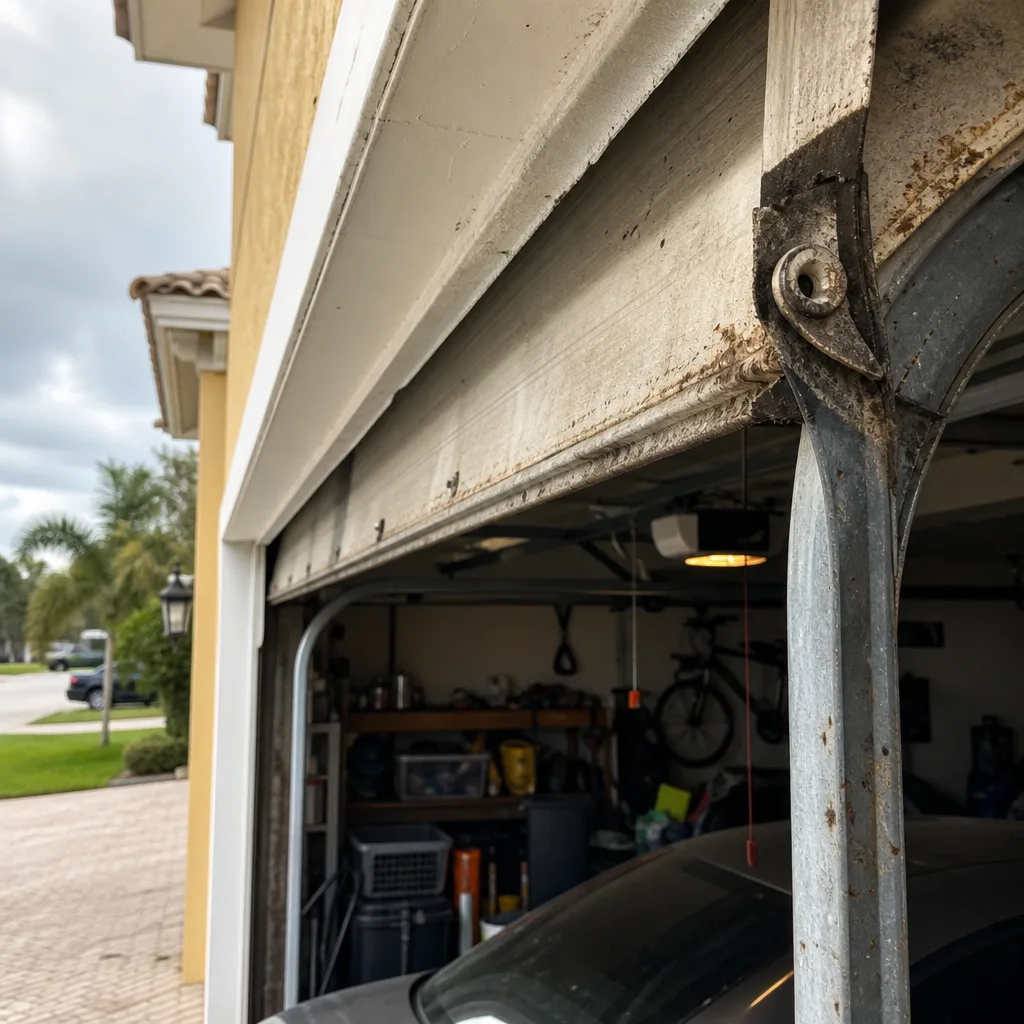
Hollywood, FL presents a specific set of conditions that affect garage doors differently than, say, a suburb in Ohio. The salt air from the Atlantic, less than three miles from most Hollywood homes, accelerates corrosion on springs, cables, and hinges. A galvanized torsion spring that might last 10,000 cycles in a dry climate often fails at 6,000 to 7,000 cycles here. Homeowners near the Intracoastal in neighborhoods like Hollywood Lakes see even faster degradation from the constant marine layer.
Hurricane season runs from June through November, and a garage door is the single largest opening in most homes. When wind pressure hits the door, the structural weak point isn’t the panel, it’s the track system and the reinforcement struts. A door that isn’t wind-rated or properly reinforced fails at the track first, and once the door goes, the internal pressure change can lift the roof. This is why the Building Code requires wind-rated doors in Hollywood, and it’s why a door that was installed in 1995 may not meet current standards even if it looks fine.
The housing stock creates its own variables. A house built in the 1970s in the 33020 zip code likely has a door opening that isn’t perfectly square anymore after decades of settling. A new panel door installed without adjusting for that uneven opening will bind, strain the opener, and wear out rollers prematurely. A house in the newer developments west of 75 has tighter tolerances, but the doors are often builder-grade units from Wayne Dalton or Craftsman that weren’t sized for heavy use or coastal conditions.
We work on whatever is already installed across Hollywood. The brand matters for parts sourcing, but the diagnosis doesn’t start with a brand preference. A Clopay door with a failed bottom bracket and an Amarr door with a broken spring get the same treatment: assess the actual condition, measure what’s out of spec, and recommend the right fix. That approach comes from experience with the full range of what’s installed in Hollywood homes, from 40-year-old Raynor doors to doors installed last year.
The DIY Installation Trap: Why Saving $800 Can Cost You $20,000
The most expensive DIY decision isn’t usually a spring replacement. It’s the full door installation. And in Hollywood, the gap between what a big-box installation costs and what a code-compliant professional installation costs is meaningful enough that some homeowners decide to handle it themselves. For a detailed breakdown, see our Garage Door Cost Breakdown: The Hollywood Homeowner’s Reference for 2026.
Here’s what’s actually involved in a code-compliant garage door installation in Hollywood: measuring the opening precisely, ordering a door with the correct wind rating for your specific location, pulling the permit, removing the old door and disposing of it, installing new tracks that are plumb and square, setting the spring tension correctly, installing and calibrating the opener, and scheduling the inspection. That’s a two-person job that professional installers do in four to six hours with the right equipment.
The DIY version usually starts with a door ordered online or from a retailer that doesn’t handle permits. The door arrives, the homeowner figures out they need a permit, waits for the permit, installs the door over a weekend, and either skips the inspection or fails it. If the inspection fails, the homeowner now has to fix whatever was flagged, which often involves calling a professional anyway. If the inspection never happens, the unpermitted work sits on the property record until a sale or an insurance claim exposes it.
The financial comparison, then, isn’t between professional installation and DIY installation. It’s between a professional installation that includes permits and compliance, and a DIY installation that doesn’t. The professional job costs more up front. The DIY job creates a contingent liability that could surface years later as a denied insurance claim or a delayed closing. In Hollywood, where hurricanes are not hypothetical and the real estate market moves fast, that liability has a way of surfacing at the worst possible moment.
For homeowners who want a new door, the professional route also solves a selection problem: big-box stores sell a limited range of doors, and the online marketplaces are full of doors that don’t meet Florida code but are marketed without clear regional distinctions. Companies like Benchmark that install doors from top-tier manufacturers (Clopay, Amarr, Wayne Dalton, Raynor) have access to product lines that are engineered for coastal wind loads and specified for Florida’s code requirements. Those doors simply aren’t available at retail.
Common Mistakes to Avoid
- Lubricating with WD-40. WD-40 is a solvent, not a lubricant. It strips the existing grease and leaves the metal drier than before. Use white lithium grease on moving metal parts and a silicone spray on the torsion spring. We see this mistake constantly in Hollywood garages.
- Adjusting the spring tension with the door up. Springs are under their highest load when the door is raised. Any attempt to adjust tension with the door open multiplies the danger. The spring should only be worked on with the door down and the opener disconnected.
- Replacing a single spring on a two-spring door. If one spring breaks, the other one is usually near the end of its life. Replacing only the broken one means you’ll be doing the job again soon, and the door will be unbalanced in the meantime. We always recommend replacing both springs, even if it costs more up front.
- Ignoring the permit requirement. Some Hollywood homeowners assume a garage door swap doesn’t need a permit. It does under the Florida Building Code. The cost of a retroactive permit is higher than pulling one proactively, and the cost of a failed sale because of unpermitted work is higher still.
- Buying the cheapest torsion spring online. Springs are sized by wire gauge, inside diameter, length, and wind direction. Buy the wrong size and the door won’t balance, which burns out the opener motor. Buy a spring not rated for coastal environments and it fails early. This is the most expensive way to save $30.
- Forgetting to test the auto-reverse after maintenance. After any work on the door or sensors, place a roll of paper towels under the door and close it. The door should reverse within two seconds of contact. If it doesn’t, the force setting is too high. This is a safety check that takes 30 seconds and most DIYers skip it.
- Painting over the photo-eye sensors. In a Hollywood home where garage interiors get repainted for mold resistance, we see sensors covered in paint overspray. A painted lens blocks the infrared beam and causes phantom reversing. If your door reverses for no reason after a paint job, check the sensor lenses first.
When to Call a Professional
Call a professional when the job involves anything under tension: torsion springs, extension springs, or lift cables. Call a professional when a new door requires a permit, which is every new installation in Hollywood. Call a professional when you’ve tried a fix and the door still doesn’t operate correctly, because you’re now dealing with a compounded problem. Call a professional when the door is off its track, when a panel is bent enough to compromise the seal, or when the opener motor runs but the door doesn’t move. These are not edge cases; they’re the majority of what we see across Hollywood service calls, and the right fix usually costs less than the wrong DIY attempt.
Benchmark Garage Door Repair offers free estimates in Hollywood. Call (833) 589-8332 and a technician will diagnose the actual problem before any work is quoted. The price is agreed before work starts. If it’s a repair, you’ll know exactly what it costs before we touch the door. If you’re weighing repair against replacement, you’ll get a brand-agnostic recommendation based on the door you actually have, not the line we prefer to sell. For anyone looking at the full scope, our Garage Door Repair in Hollywood service is the starting point, and we also handle Garage Door Opener Repair in Hollywood as a separate discipline for mechanical, motor, and smart-home integration issues.
Frequently Asked Questions
No. Torsion springs are under enough tension to cause serious injury or death if they fail during installation, and the CPSC attributes roughly 30,000 garage door injuries annually, mostly spring-related. Extension springs on older Hollywood doors are equally dangerous without a safety cable in place. Hire a professional for any spring work.
Yes. The Florida Building Code requires a permit for garage door replacement, and Hollywood falls within the High Velocity Hurricane Zone in Broward County, which means the door must meet specific wind-load requirements. A professional installer pulls the permit and schedules the inspection as part of the job.
Weatherstripping replacement, sensor realignment, track and roller lubrication, remote reprogramming, and visual inspections are all safe DIY tasks. None of these require touching components under tension or lifting the door’s full weight, and none creates a permit or insurance issue.
A professional diagnostic visit in Hollywood generally falls between $75 and $125, and many companies apply that fee toward the repair if you proceed. That’s cheaper than buying two wrong parts on a guess, which is a common DIY outcome, especially with opener issues that mimic spring failures.
It can. If a hurricane damages your home and the adjuster finds that the garage door was installed without a permit or wasn’t wind-rated for Hollywood’s code requirements, your claim can be denied or reduced. Unpermitted work can also create title problems when you sell.
A brand-specific dealer knows one product line deeply. A multi-brand specialist works on whatever is already installed, which matters because Hollywood homes have a mix of doors and openers from different eras and manufacturers. Garage Door Installation in Hollywood through a multi-brand specialist also gives you access to professional-grade product lines from manufacturers like Amarr and Wayne Dalton that aren’t sold at retail.
The Bottom Line
The DIY-versus-professional decision on a garage door isn’t about pride or capability. It’s about what you’re exposed to when the project goes wrong, and in Hollywood, the exposure includes your body, your insurance coverage, and your ability to sell your house. The tasks that are safe to DIY are genuinely safe, and you should handle them. The tasks that aren’t are not edge cases. A torsion spring under load doesn’t care how handy you are. A building inspector doesn’t care that you saved $800. Florida’s wind-load requirements and permit system make garage door work a different category of responsibility here than in most of the country. If the job touches tension, needs a permit, or has already survived one failed DIY attempt, call someone who does this work in Hollywood every day. The free estimate costs less than the second wrong part.
Written by the team at Benchmark Garage Door Repair, serving Hollywood since 2011.
See the difference
 Before
 After
 Before
 After
 Before
 After